
The Indian economy recorded a six-quarter high growth of 8.2 per cent in July-September, as factories churned out more products in anticipation of a consumption boost from the GST rate cut, according to government data.

'The finance minister has done as much as she can when you look into the fiscal constraints she had.'

The Reserve Bank of India's (RBI's) job to bring down inflation is not over, and any premature move on the policy front could undermine the success achieved so far on the price situation, according to RBI Governor Shaktikanta Das. RBI's rate setting panel, Monetary Policy Committee (MPC), had met for three days from February 6-8. The panel decided to leave the key policy rate unchanged at 6.5 per cent for the sixth time in row.

'Trump had done a deal with the current regime minus Maduro. The current regime is giving Trump entry into Venezuelan oil. They are obeying him and doing whatever he says.' 'They are happy because they have saved their heads by sacrificing only two, Maduro and his wife. Thousands of Venezuelan military leaders would have been jailed or killed in American action had Maduro stayed in power.'

Uncertainties over the impact of the United States' (US') tariffs on India, along with the ongoing transmission of past rate cuts, prompted the members of the Reserve Bank of India's Monetary Policy Committee (MPC) to maintain the status quo during the August meeting, the minutes showed. While some of the external members highlighted their concern over growth, the internal members cited the one-year headline inflation rate overshooting the 4 per cent target.

The World Bank on Tuesday raised India's growth forecast for the current fiscal to 6.5 per cent from 6.3 per cent estimated earlier, and said the country is expected to remain fastest-growing major economy, underpinned by continued strength in consumption growth.

'April 9 announcement of slapping a 125% tariff on Chinese goods has brought the focus back to China, making this new phase feel like a repeat of the original conflict.'

'...not merely in managing fiscal mathematics, but in demonstrating conservatism and prudence within that framework.' 'Looking forward, we believe sufficient growth drivers exist -- ranging from government reforms to revival in consumption to favourable monsoons. Numerous factors support the Indian economy.'

'Having a separate healthcare corpus is extremely important even for those already covered by health insurance.'

Retail inflation breached the Reserve Bank's upper tolerance level, soaring to a 14-month high of 6.21 per cent in October mainly on account of rising food prices. Inflation based on the consumer price index (CPI) was 5.49 per cent in September and 4.87 per cent in the year-ago month. Retail inflation trended below the RBI's upper tolerance band of 6 per cent since September last year.

The Reserve Bank on Friday raised the inflation projection for current fiscal year to 4.8 per cent from 4.5 per cent with Governor Shaktikanta Das saying lingering food price pressures are likely to keep headline inflation elevated in the December quarter. Consumer price index (CPI)-based inflation increased sharply in September and October 2024 led by an unanticipated increase in food prices.

Ask rediffGURU Naveenn Kummar your insurance mutual fund and personal finance-related questions.
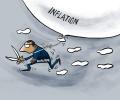
Wholesale price based inflation declined to a 3-month low of 1.89 per cent in November on cheaper food items, and experts predicted a 0.25 per cent interest rate cut by the RBI in the policy review in February. The Wholesale Price Index (WPI) based inflation was 2.36 per cent in October 2024. It was 0.39 per cent in November, last year. In August, 2024, it was 1.25 per cent.

The Reserve Bank of India's (RBI's) caution on inflation, highlighted during the recent monetary policy meeting, may put investors' faith in fast moving consumer goods (FMCG) stocks to test, analysts said. They, however, believe FMCG stocks may ride through this near-term investor anxiety as related companies are, typically, well-equipped to handle inflation due to their pricing power and steady demand for essential goods.

The Reserve Bank's rate setting panel on Thursday met to finalise a report for the government on why it failed to keep retail inflation below the target of 6 per cent for three consecutive quarters since January this year, said sources. The report will be presented to the government as per the Reserve Bank of India Act, they added. The six-member Monetary Policy Committee (MPC) is headed by Governor Shaktikanta Das.

Reserve Bank Governor Sanjay Malhotra on Wednesday said there is no proposal to levy any charge on UPI transactions.

The government on Monday ruled out making public the RBI report detailing the reasons why the central bank could not keep inflation within the targeted 6 per cent upper limit for the three consecutive quarters. "Yes sir, RBI has furnished a report to the central government, as mandated under Section 45ZN of the RBI Act, 1934 and Regulation 7 of RBI Monetary Policy Committee and Monetary Policy process Regulations, 2016," minister of state for finance Pankaj Chaudhary said in a written reply. The said provisions of the RBI Act, 1934, and regulations therein does not provide for making the report public, he said.

An article on 'State of the Economy' in the monthly Bulletin also said the improvement in the outlook for agriculture and the revival of rural spending have turned out to be the bright spots in the evolution of demand conditions. Consumer price inflation ticked up in June 2024 after three consecutive months of moderation as a broad flare-up in vegetable prices halted the overall disinflation that had been underway, it said.

Ask rediffGURU Naveenn Kummar your insurance mutual fund and personal finance-related questions.

'It was like rigorously preparing for a solid, good exam...' 'I don't know what marks I will get, but I felt the rigorous preparation of an exam.' 'You may sweat, but I feel rejuvenated.'
Most members of the Reserve Bank of India's monetary policy committee (MPC) decided to stick to the course on bringing retail inflation to the target of 4 per cent while voting for maintaining status quo in the April review, except external member Jayanth Varma who voted for a 25 bps cut in the repo rate. "I believe that the extant monetary policy setting is well positioned," RBI governor Shaktikanta Das said in the minutes of the policy review, which came out on Friday. "Monetary policy transmission is continuing and inflation expectations of households are also getting further anchored.

New investors should not allow themselves to fall prey to FOMO and rush headlong into gold.

Retail inflation in August inched up to 3.65 per cent, though vegetables and pulses witnessed price rise in double digits, according to official data released on Thursday. The retail inflation based on the Consumer Price Index (CPI), however, remained below the Reserve Bank's median target of 4 per cent for the second month in a row. It was at a five-year low of 3.6 per cent in July.

'Someone posts a job on LinkedIn and there are a thousand resumes in an hour? This is not the America IT professionals are used to.' 'Once they lose their job, it's impossible to get a job.'

Ask rediffGURU and PF, MF and insurance expert Purshotam Lal your mutual fund, insurance and personal finance-related questions.

The Budget should undertake further reductions in import tariffs and seriously consider an announcement of India's intention to join one or both of the two Asian mega-regional free trade agreements, suggests Shankar Acharya, former chief economic adviser to the Government of India.

From the Sensex firms, Tata Motors jumped the most by 5.54 per cent, followed by Kotak Mahindra Bank, Trent, Sun Pharma, Axis Bank, and ICICI Bank. However, Bajaj Finance, State Bank of India, UltraTech Cement and Tata Steel were among the laggards.

'RBI is already late in addressing inflation pressures.'
Analysts are divided on their retail price inflation forecast, with some saying the first quarter numbers will overshoot the RBI target by as much as 60 bps while others are softer in their estimate. Consumer price inflation retreated from its 15-month peak of 7.4 per cent in July to 6.8 per cent in August, much lower than the market expectations, despite vegetable prices remaining elevated at 26.1 per cent. Food inflation eased to 9.9 per cent from 11.5 per cent, led by some cooling of inflation in vegetables, cereals, pulses and milk.

'An eerie similarity with 2019 inflation trajectory could now mean that the RBI and market inflation estimates could go awry.'

Analysts expect Nifty to rise up by to 6 per cent in six months, with intermittent corrections likely due to global factors.
All six members of the Reserve Bank of India's (RBI's) monetary policy committee (MPC) expressed caution over food inflation during the December review, while two external members warned about high real interest rates as headline inflation approaches its target of 4 per cent. The central bank continued to maintain the status quo on both the repo rate and the stance in the December monetary policy. India's retail inflation in November rose to 5.5 per cent - its fastest pace in three months - due to higher food prices.
The government on Tuesday appointed three external members -- Ram Singh, Saugata Bhattacharya and Nagesh Kumar -- to the RBI's rate-setting Monetary Policy Committee for four years. The central government has reconstituted the Monetary Policy Committee (MPC) of RBI, the finance ministry said in a statement. Ram Singh is the director of the Delhi School of Economics, Saugata Bhattacharya is an economist, and Nagesh Kumar is the director and Chief Executive, Institute for Studies in Industrial Development, New Delhi.

Ask rediffGURU and PF expert Nitin Narkhede your mutual fund and personal finance-related questions.

India's top listed real estate developers - DLF, Lodha Group, Prestige Estates, and Oberoi Realty, excluding Godrej Properties - reported strong presales growth in the first quarter (Q1) of 2025-26 (FY26), even as earnings showed a mixed trend. According to Nomura, the top five developers - DLF, Lodha, Prestige, Oberoi, and Godrej - recorded a cumulative 59 per cent year-on-year (Y-o-Y) growth in presales.

Inflation rate during August, the data for which is yet to be released, was likely to remain at about 7 per cent, said SBI Ecowrap.
Retail inflation declined to a five-year low of 3.54 per cent in July mainly on account of subdued prices of food items, and base effect, according to official data released on Monday. The Consumer Price Index (CPI) based retail inflation was 5.08 per cent in June 2024 and 7.44 per cent in July 2023.

With inflation comfortably below the Reserve Bank of India's (RBI's) 4 per cent median target and likely to undershoot its 3.7 per cent projection for 2025-26 (FY26), there is room for the monetary policy easing cycle to be sustained, the Finance Ministry said on Monday. The comments, featured in the ministry's Monthly Economic Review for June 2025, assume significance ahead of the Monetary Policy Committee (MPC) meeting of the Reserve Bank of India (RBI) scheduled to begin from August 5.
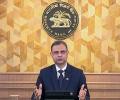
The weakening of inflation, prospects of economic growth, geopolitical uncertainty and comfortable system liquidity may result in the Reserve Bank of India's (RBI) Monetary Policy Committee (MPC) to cut the repo rate by another 25 basis points, opine top economists. They also said the external economic pressures like trade policies and others would require continued RBI's accommodative stance and policy support for the Indian industry to sustain the growth.

He argued that if inflation is low, stable and moving towards the 4 per cent target, why has the RBI not revised downward the bank rate fixed in June 2023?
